
Understanding the Meaning and Origin of the Phrase Take the Cheese in Modern Usage
Understanding the Meaning and Origin of the Phrase "Take the Cheese" in Modern Usage
Introduction
The phrase "take the cheese" has increasingly become a point of curiosity among language enthusiasts and casual speakers alike. While it might sound like a simple idiom related to dairy products, its contemporary usage often conveys meanings far removed from the literal interpretation. This article aims to explore the origins, evolution, and current applications of the phrase "take the cheese" in modern English. By understanding how this expression has developed over time, readers can gain insight into the fluid nature of language and the cultural factors that influence phraseology.
The Literal Meaning of Cheese in English
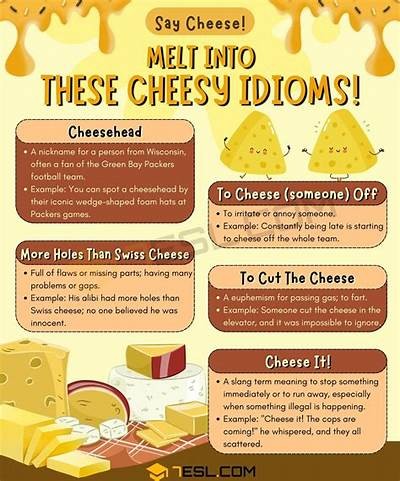
To appreciate the phrase "take the cheese," it helps first to consider the word "cheese" itself. Cheese, a dairy product made from curdled milk, has been a staple in human diets for thousands of years. The word "cheese" originates from the Old English word "cēse," which was borrowed from Latin "caseus," meaning cheese. Over time, "cheese" has taken on various metaphorical and idiomatic meanings in English.
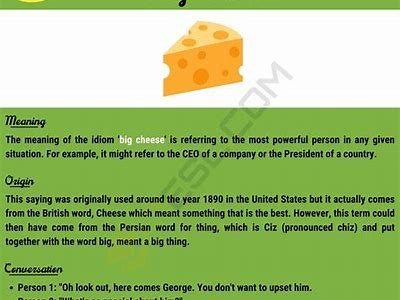
In everyday language, cheese often symbolizes something valuable or desirable, sometimes referring to money or profit. For example, the phrase "the big cheese" means an important person, while "cheddar" is a slang term for money. This metaphorical use of cheese sets the stage for idiomatic expressions like "taking the cheese."
The Historical Origins of "Take the Cheese"
The phrase “take the cheese” does not have clear documentation in classical dictionaries or idiomatic references from centuries past. However, the closest antecedent might be the idiom “take the biscuit” or “take the cake,” both meaning that something is surprising, remarkable, or sometimes frustrating. These expressions emerged in English by the early 20th century and refer to winning or deserving some kind of figurative prize.

“Take the cheese” likely derives from a playful variation on these expressions, possibly influenced by the synonymous use of cheese as a prize or reward. It is important to note that this phrase has circulated more informally in certain regions or subcultures, causing its history to be less thoroughly documented. Some speculate that the phrase was popularized via colloquial settings, such as university dialects, gaming communities, or specific workplace jargon.
Modern Idiomatic Meanings of "Take the Cheese"
In modern English, the expression “take the cheese” often means to win or secure a reward or benefit, sometimes unexpectedly or competitively. It can imply someone claiming the best part of a situation, overcoming challenges to achieve success, or gaining a prize that others were hoping to obtain. For example, in a context where several candidates compete for a job, the one who “takes the cheese” is the one who gets hired.
In some cases, the phrase is used sarcastically or humorously to highlight greed or over-ambition. Saying someone “takes the cheese” could imply that they grab the best portion without concern for others. In such usage, the phrase becomes a subtle commentary on selfish behavior.
Use in Popular Culture and Media
The phrase “take the cheese” has appeared sporadically in various media forms, including movies, television shows, and video games, although not as prevalently as other cheese-related idioms. Its use often aligns with themes of competition, success, or reward.
In some gaming communities, “taking the cheese” can refer to a player who exploits a game’s mechanics to gain an unfair advantage or a shortcut to victory, which has led to further semantic flexibility. Meanwhile, in advertising or marketing contexts, the phrase might be employed metaphorically to suggest winning a prize or achieving a goal.
Comparison with Similar Idioms
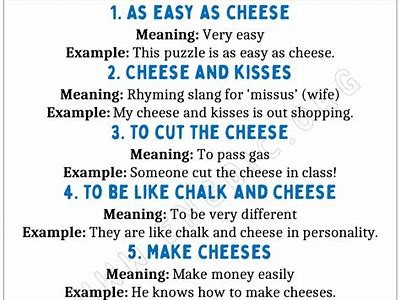
To better understand the nuances of “take the cheese,” it helps to compare it with related idioms such as “take the cake,” “take the biscuit,” “cut the cheese,” and “big cheese.” While “take the cake” and “take the biscuit” both refer to surpassing all others, often with a hint of surprise or disbelief, “cut the cheese” usually refers humorously to passing gas, entirely unrelated to rewards or competition.
“Big cheese,” on the other hand, denotes a person of importance or high status, which might be the origin point for the idea of cheese representing a “prize” or “reward.” Thus, “take the cheese” can be positioned as an informal idiom denoting acquisition of something valuable, aligning with these related expressions.
Regional Variations and Usage
The usage and understanding of “take the cheese” can vary significantly by region and cultural context. In some English-speaking communities, the phrase remains rare or benign, while in others, especially in informal or youth slang, it has become more common as a phrase implying winning or seizing an opportunity.
For instance, in certain American subcultures, “take the cheese” might be used in music lyrics or social media posts to express triumph. However, it is less frequently recognized in more formal registers of English. The phrase’s meaning depends heavily on context and often requires cultural or social knowledge to decode properly.
How to Use "Take the Cheese" Correctly
For speakers wanting to incorporate "take the cheese" into their vocabulary, it is essential to use it in situations involving competition, reward, or gain. Examples include:
- “After months of hard work, she finally took the cheese and earned the promotion.”
- “They tried to undercut us, but we took the cheese at the last minute.”
- “He always tries to take the cheese when the team splits the bonus.”
Avoid using the phrase in literal contexts or where its meaning might be confusing without prior explanation. Understanding the audience’s familiarity with the idiom can help ensure effective communication.
Conclusion
The phrase “take the cheese” is an intriguing example of how language evolves and how idioms can emerge from playful or metaphorical uses of everyday objects. While not as established or widespread as some other idioms, it carries a versatile meaning relating primarily to the act of winning, gaining, or securing a prize or reward. Its informal and sometimes humorous connotations make it a useful expression within certain conversational and cultural contexts.
By tracing its origins, understanding related idioms, and recognizing regional usage differences, speakers and learners of English can better appreciate and use this phrase effectively. As with many idiomatic expressions, the key to mastering "take the cheese" lies in experiencing it within natural discourse and media where its meaning comes alive.